How to run an AI visibility audit for a client
Buyer questions on ChatGPT, Gemini and Google AI Overviews, each asked more than once: what to count, how to read the range and the one page you hand the prospect, shown on real answers.
In short
- An AI visibility audit asks the questions a client’s buyers ask on ChatGPT, Gemini and Google AI Overviews, and counts how often each brand is named.
- Ask every question at least twice and report a rate with its range: AI answers change from one run to the next, so one answer proves little.
- Hand over one page: the verdict, who gets named instead, the pages the engines cite and a 90-day plan.
On this page10 sections
What the audit has to answer
A prospect doesn’t want a score. They want three answers. When a buyer asks ChatGPT, Gemini or Google for a recommendation in their category, are they named? If not, who is? And what are the engines reading that leads them there?
It matters because the AI answer is often the whole visit. In Pew Research Center’s browsing data, Google users who saw an AI summary clicked a regular result in 8% of visits, against 15% when there was no summary [1]. A brand that isn’t in the answer rarely gets a second look further down the page.
Below is how we run one. You can do it by hand with a spreadsheet and an afternoon; in Menzio it’s one form. The screenshots show our real report on real answers from a test we ran on October 28, 2026, for a tool that finds local businesses without a website. Every company name in them is made up.
Step 1: write the buyer questions
Start from the prospect’s buyers, not from their keyword list. People type full questions into an assistant: “best tool to find local businesses without a website”, not “lead gen software”. Write them in lowercase, the way people type, and leave the prospect’s name out. You’re measuring whether the engines bring them up on their own.
Mix the intents. Most questions should ask for a recommendation, because that’s where brands get named. Add the problem the product solves, and one or two that name the market leader.
The 10 questions of the test, by intent
| Questions | Example | |
|---|---|---|
| Best X for Y | 6 | best tool to find local businesses without a website |
| The problem | 3 | how do freelance web designers find clients |
| Alternatives | 1 | alternatives to Orbitly for finding leads |
Our audits use 20 questions: enough to see a pattern, few enough to read every answer. If you can, add a few buying questions (price, reviews) and check the list with the client’s sales team: they hear the real wording on every call.
Step 2: ask each one more than once
Assistants don’t give the same answer twice. In a study by SparkToro and Gumshoe, 600 volunteers ran 12 prompts through ChatGPT, Claude and Google’s AI 2,961 times. The chance of getting the same list of brands in two answers was under 1 in 100 [2]. One screenshot of one answer won’t convince a skeptical prospect.
So ask each question at least twice on each engine, a few minutes apart, and keep every answer word for word with its date and the pages it cites. Our audit asks 20 questions twice on ChatGPT, Gemini and Google AI Overviews: 120 answers.
The test in the screenshots is smaller: 10 questions, asked twice on ChatGPT and once on Gemini and Google AI Overviews. Five of the ten AI Overview calls failed at our data provider, which leaves 35 answers.
Question by question: one mark per answer
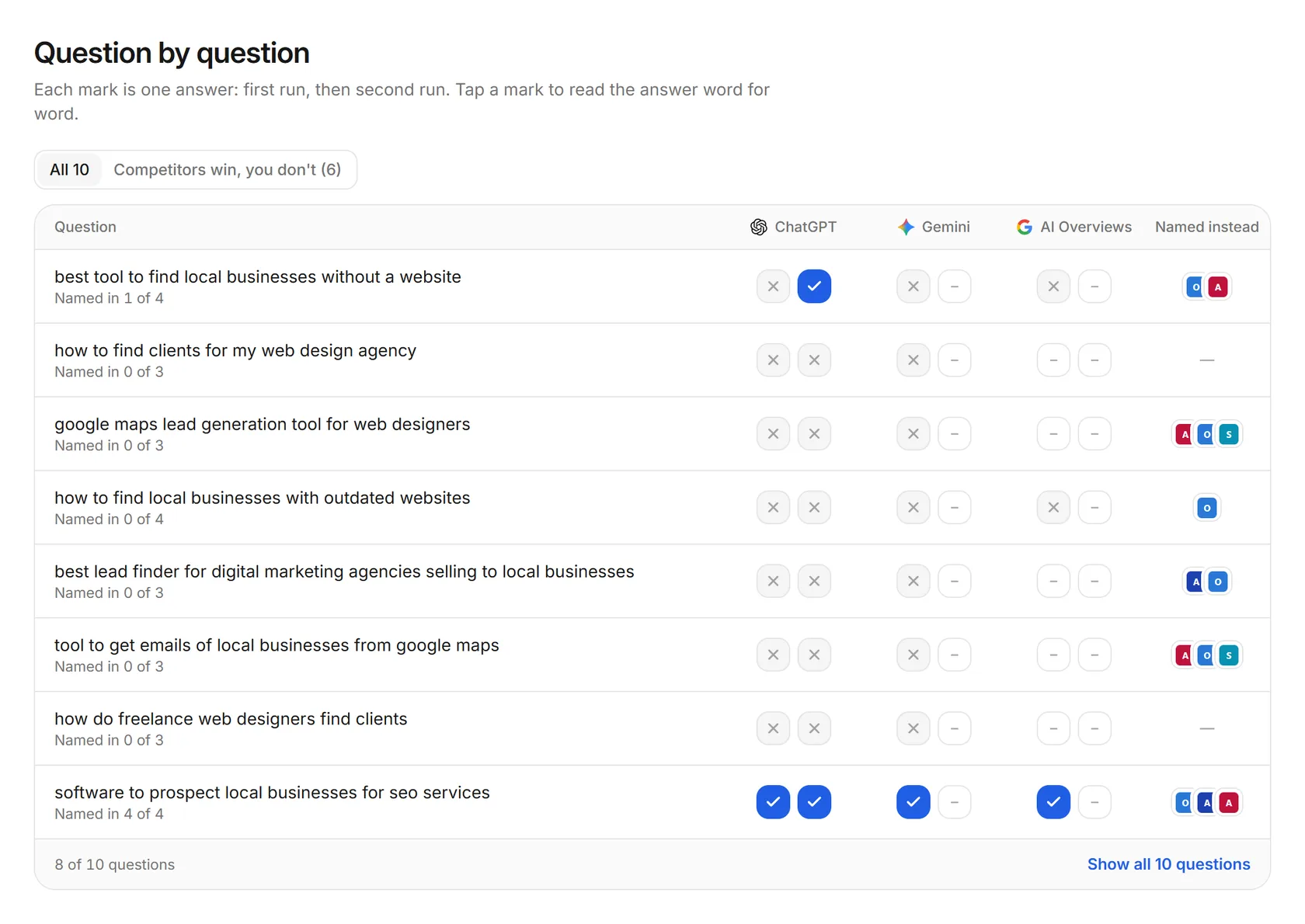
Look at the first question: ChatGPT left the brand out in one run and named it in the next. That’s why you ask twice. A dash is an answer that doesn’t exist: a run that wasn’t collected or a call that failed. It never counts as “not named”.
Step 3: count mentions, not positions
For each answer, write down two things: is the brand named as an option, and is its site cited as a source? Named is what the buyer reads. Cited is a link, and often a different set of pages.
Then report the share with its range. In the test, the brand is named in 5 of 35 answers: 14%. With 35 answers the true rate could reasonably sit anywhere from 6% to 29%. We use the Wilson interval for that range [3], the same method as in every report (how we measure). More answers make the range narrower, and it tells the client how big a change next month has to be before it means something.
The verdict: how many answers name the prospect
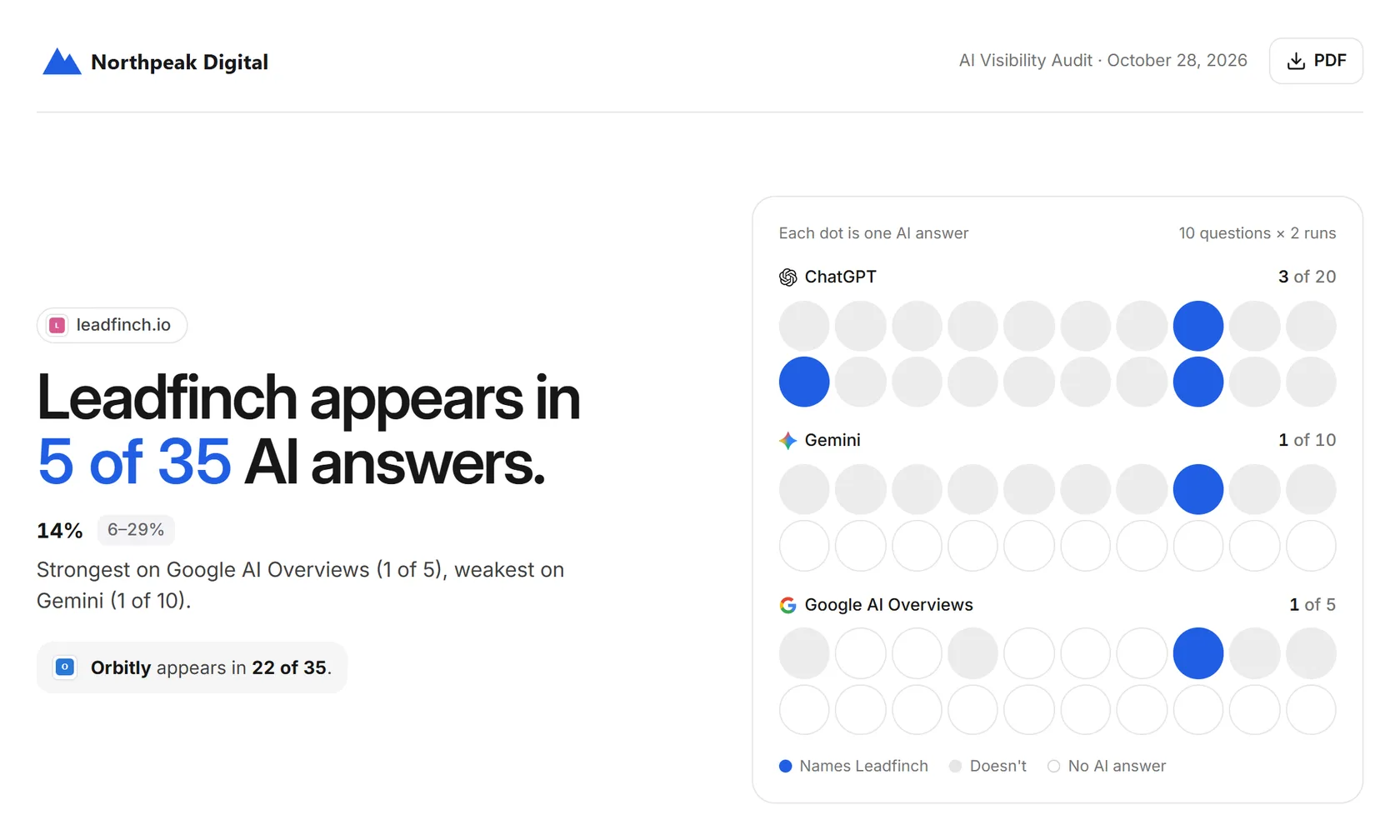
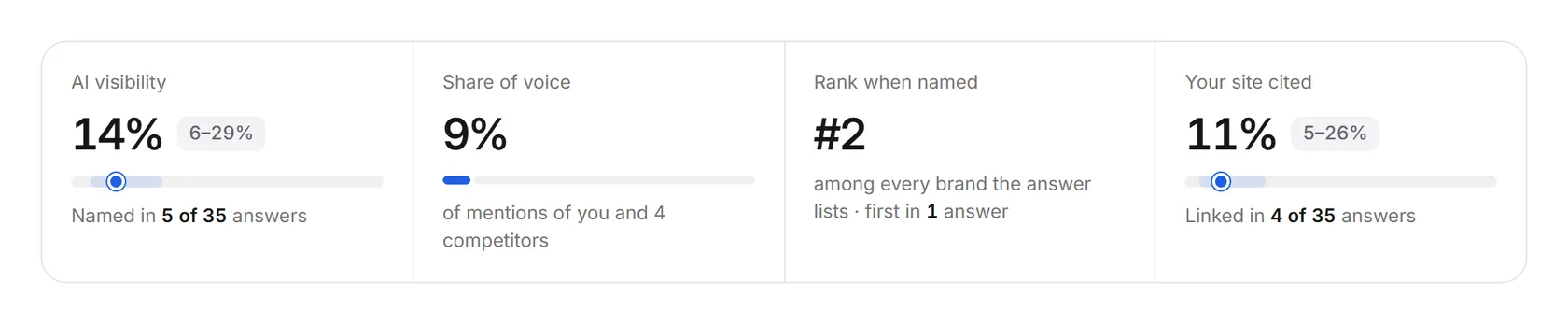
Skip the “rank #1 in ChatGPT” claim. The same study found that getting the same list in the same order was closer to 1 in 1,000[2]. The order inside one answer is noise; how often a brand appears across many answers is the number that holds up. Our report shows the average position only as context, next to the share of voice and how often the site is cited.
The four numbers under the verdict
Step 4: show who gets named instead
The verdict stings less than the next part: a competitor named in most answers. List every brand the answers name, with the same counting and ranges, and put the prospect in that list. Then split it by engine. In the test, the leader is named in 22 of 35 answers, and in all 5 AI Overviews, while the prospect comes last of five.
Who AI recommends instead, overall and engine by engine
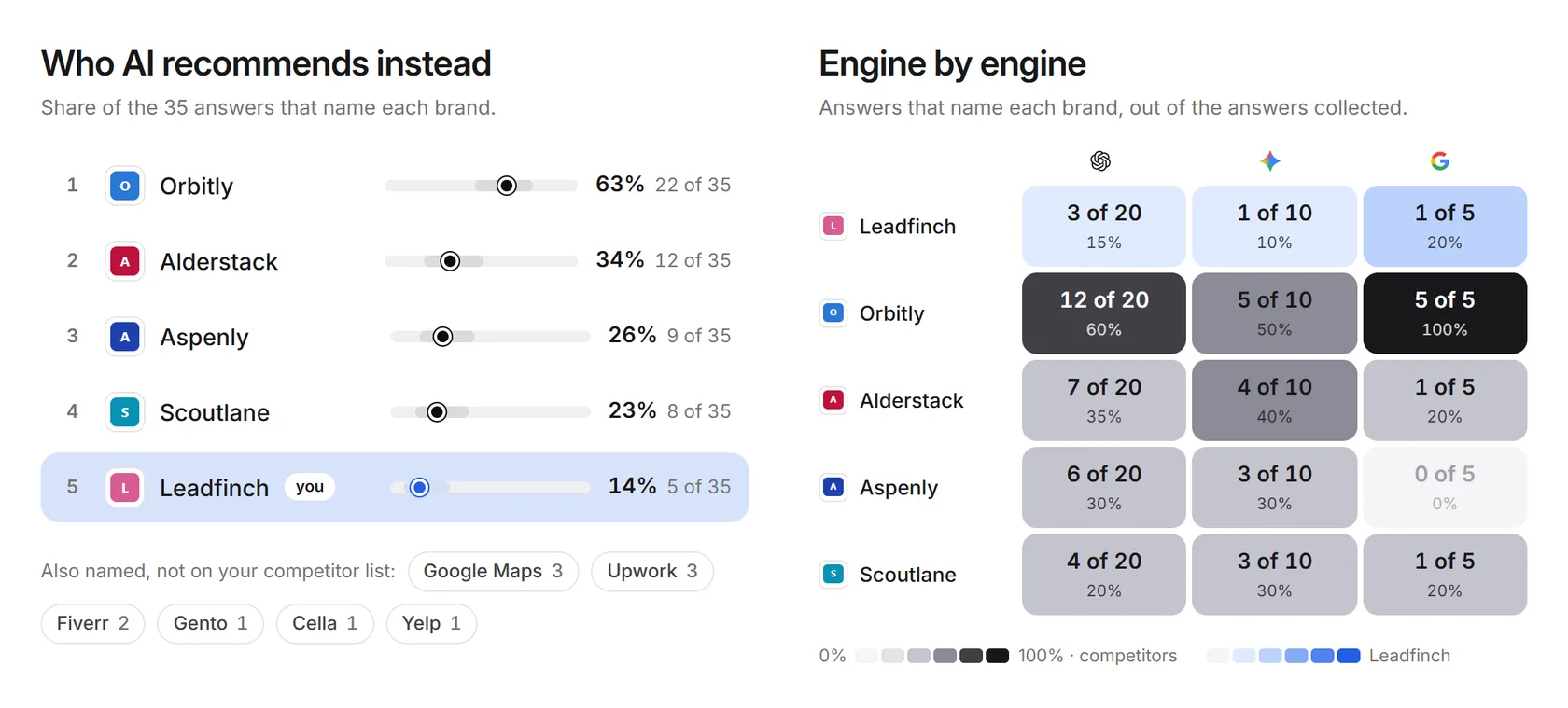
Watch the names nobody put on the competitor list. Here the answers also name Google Maps, Upwork and Fiverr: places, not software, but they compete for the same sentence.
Step 5: find the pages the engines read
Answers lean on pages you can open: the vendors’ own sites, list articles, review sites, forums, videos. Count the domains each engine cites and mark the ones that mention competitors but not the prospect. Getting listed on those pages is the most direct way to change an answer.
Where AI gets its answers: the pages that cite competitors first
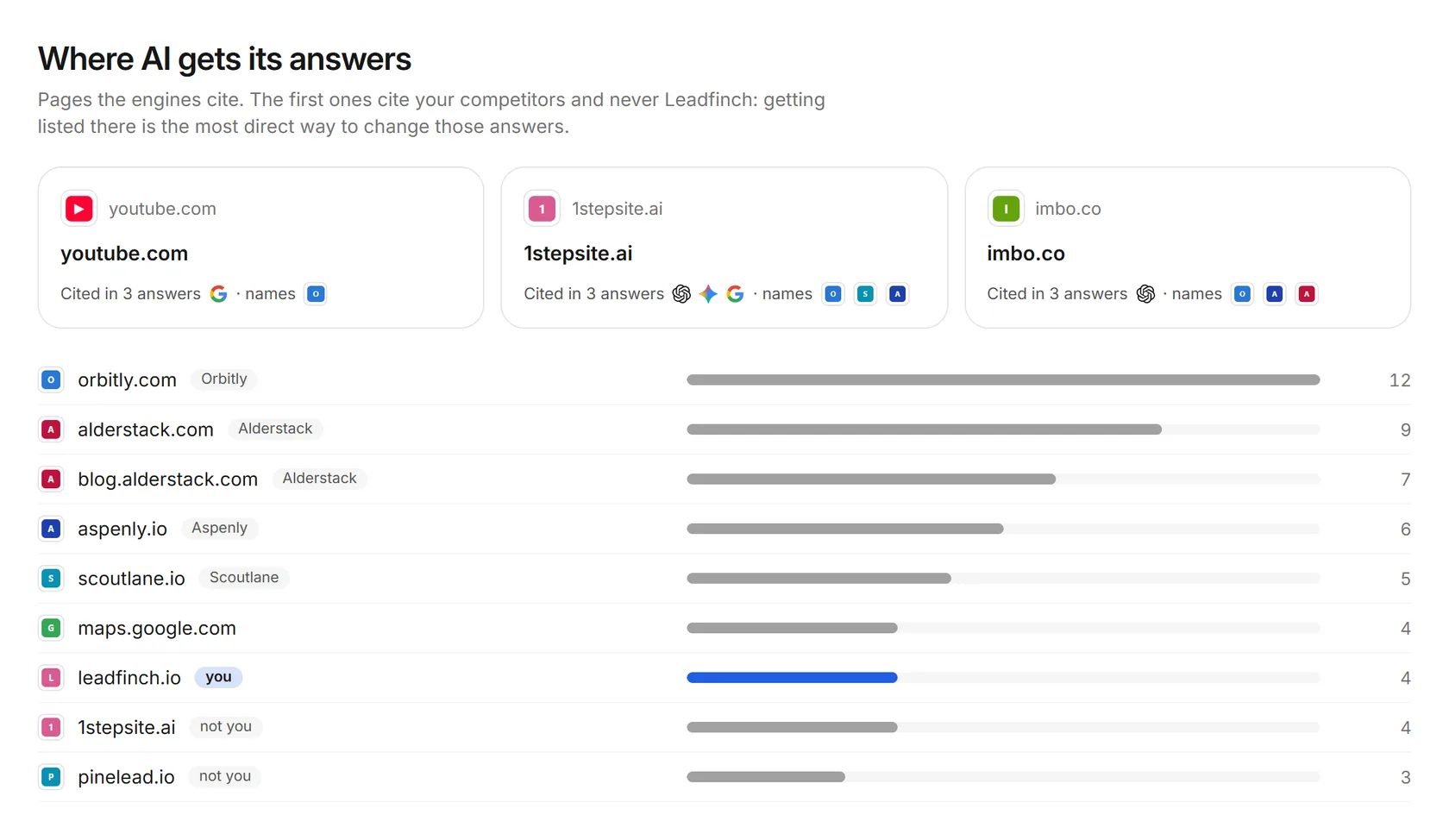
In the test, the competitors’ own sites are the most cited, and three sites name competitors in 3 answers each without naming the prospect, one of them YouTube. Before you blame the content, check the plumbing. Google says a page has to be indexed and eligible to show a snippet to appear as a link in AI Overviews, and that there are no extra requirements [4]. ChatGPT won’t show a site in its search answers if robots.txt blocks OAI-SearchBot [5]. Our free AI crawler checker reads a robots.txt and shows which AI crawlers it lets in.
Step 6: one page and a 90-day plan
The prospect won’t read every answer. They’ll read one page: the verdict, who gets named instead, the pages to get onto and what to do first. Tie every claim to an answer they can open and read word for word.
Order the plan by effort and impact, so the first month already shows movement:
- Days 1–30, quick wins: things that take an afternoon, like a short video that answers a question the prospect lost.
- Days 31–60, the biggest gaps: getting listed on the pages that cite competitors, and pages that answer the questions the prospect loses.
- Days 61–90, slower work: comparison pages and anything that needs the client’s team.
The 90-day plan, built from the numbers above
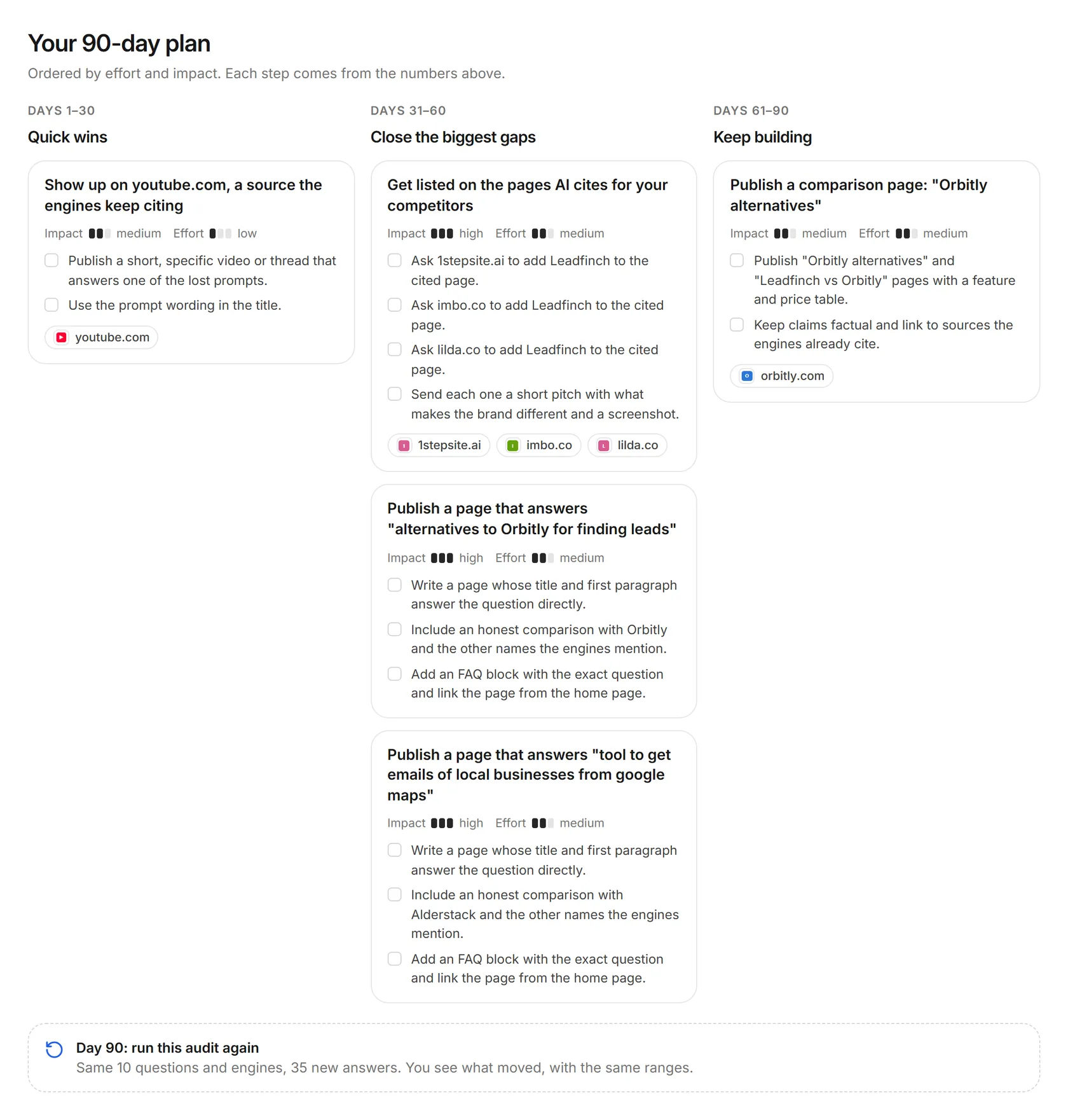
On day 90, ask the same questions again on the same engines, the same way. The client sees what moved, with its range, and you have the first month of a retainer.
Walking a prospect through it
- Open with their number. “You’re named in 5 of 35 answers” lands harder than any slide about AI search.
- Read one answer out loud, ideally one that names their main competitor. That’s when it stops being abstract.
- Show the range before they ask. It tells them you measured, not guessed.
- Promise the method, not a position. Nobody can guarantee a mention. You can guarantee the same measurement every month.
Running it in Menzio
Everything above works with a spreadsheet. In Menzio, an audit is one form: type the prospect’s domain and it reads their site to suggest 20 buyer questions and the main competitors, all editable. It asks each question twice on ChatGPT, Gemini and Google AI Overviews and builds the page you saw above, plus a 3-page PDF.
- The link needs no login, lasts 30 days and can be turned off. You get an email the first time it’s opened.
- On Growth and Scale it carries your logo and colors. On other plans you can buy audits one at a time with credits, and those carry our name.
- When the prospect signs, “Convert to client” turns the same questions and competitors into a tracked brand, measured every day.
Sources
- 1.Google users are less likely to click on links when an AI summary appears in the results · Pew Research Center · checked Nov 6, 2026
- 2.AIs are highly inconsistent when recommending brands or products · SparkToro · checked Nov 6, 2026
- 3.Binomial proportion confidence interval (Wilson score) · Wikipedia · checked Nov 6, 2026
- 4.AI features and your website · Google Search Central · checked Nov 6, 2026
- 5.Overview of OpenAI crawlers · OpenAI · checked Nov 6, 2026
Try the quick version on a prospect
Three buyer questions on ChatGPT, Gemini and Google AI Overviews, free and without signup: a fast way to see whether a full audit is worth pitching.
Free · no signup · ChatGPT, Gemini and Google AI Overviews
Changes to this page
- November 6, 2026: First published.
- November 9, 2026: A converted audit is now measured every day.